Khóa học
IELTS Online
IELTS Online
Giảm đến 18%
Đăng ký ngay
Mục lục [Ẩn]
Dạng bài matching information IELTS Reading là một trong những “nỗi ám ảnh” của nhiều thí sinh bởi độ khó và dễ gây nhầm lẫn. Nếu bạn thường xuyên mất điểm ở dạng này, đừng lo! Trong bài viết dưới đây, bạn sẽ được hướng dẫn cách làm chi tiết kèm theo bài tập matching information IELTS Reading giúp luyện tập hiệu quả và nâng band nhanh chóng.
| Bạn đang ở band IELTS bao nhiêu? Làm bài test miễn phí và nhận ngay lộ trình học cá nhân hóa. 👉 Đăng ký test IELTS miễn phí ngay |
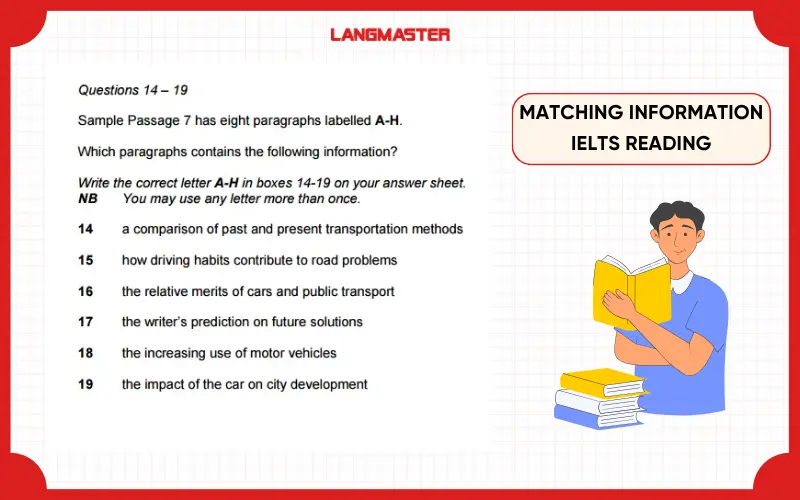
Matching Information là một dạng bài phổ biến trong IELTS Reading, yêu cầu thí sinh nối các thông tin (statements) với đoạn văn (paragraphs) phù hợp trong bài đọc. Thông tin cần tìm có thể là ý chính, chi tiết cụ thể, ví dụ minh họa, lý do, hoặc nhận định của tác giả.
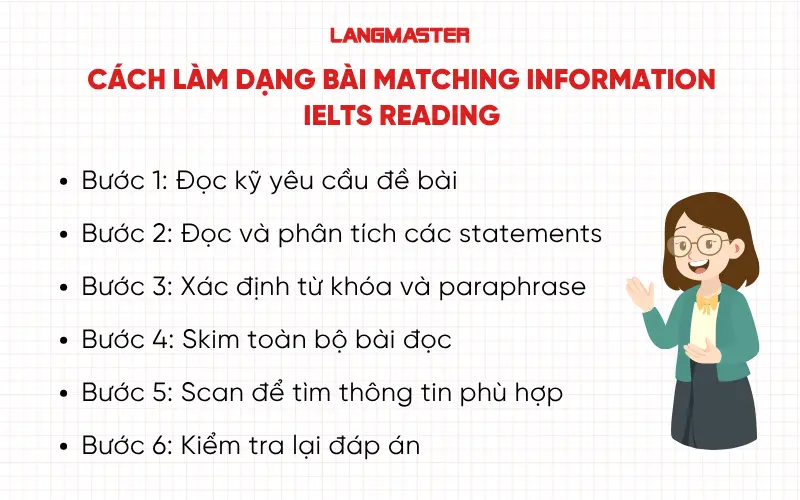
Cách làm dạng bài Matching information trong IELTS Reading bao gồm các bước:
>> Xem thêm:
The Development of Renewable Energy
A. For much of modern history, global energy demand has been largely met by fossil fuels such as coal, oil and natural gas. These resources have powered industrial development and economic growth for over a century. However, concerns about environmental damage and climate change have prompted governments and scientists to search for cleaner alternatives.
B. Solar energy has become one of the most promising renewable energy sources. By using photovoltaic panels, sunlight can be converted directly into electricity. As technology has improved, the cost of solar power has fallen significantly, allowing more households and businesses to adopt this form of energy.
C. Wind energy has also expanded rapidly in recent decades. Large wind turbines installed on land or offshore can generate substantial amounts of electricity. Many countries have invested heavily in wind farms as part of their strategy to reduce carbon emissions and decrease dependence on fossil fuels.
D. Despite the rapid growth of renewable energy technologies, several obstacles remain. Renewable sources such as solar and wind are dependent on weather conditions, meaning electricity production may fluctuate throughout the day. This variability creates challenges for maintaining a stable energy supply.
E. To address these limitations, researchers are developing advanced energy storage technologies. Large-scale batteries and other storage systems can store excess electricity generated during periods of high production and release it when demand increases. Such solutions are essential for ensuring the reliability of renewable energy systems.
F. As renewable energy continues to develop, international cooperation has become increasingly important. Governments, scientific institutions and private companies are collaborating to share knowledge, improve technology and accelerate the global transition toward sustainable energy systems.
Questions 1–6
Choose the correct heading for each paragraph from the list below.
List of Headings
i. International collaboration in renewable energy development
ii. The role of energy storage technologies
iii. The growing use of wind power
iv. The historical dependence on fossil fuels
v. The advantages and growth of solar power
vi. The challenges of relying on renewable energy
vii. Government taxation on fossil fuels
viii. Public opposition to wind farms
1. Paragraph A
2. Paragraph B
3. Paragraph C
4. Paragraph D
5. Paragraph E
6. Paragraph F
Đáp án
1. A - iv
2. B - v
3. C - iii
4. D - vi
5. E - ii
6. F - i
>> Xem thêm: Lộ trình tự học IELTS Reading từ 0 đến 7.0 hiệu quả tại nhà
Why being bored is stimulating
Paragraph A
We all know how it feels – it’s impossible to keep your mind on anything, time stretches out, and all the things you could do seem equally unlikely to make you feel better. But defining boredom so that it can be studied in the lab has proved difficult. For a start, it can include a lot of other mental states, such as frustration, apathy, depression and indifference. There isn’t even agreement over whether boredom is always a low-energy, flat kind of emotion or whether feeling agitated and restless counts as boredom, too. In his book, Boredom: A Lively History, Peter Toohey, at the University of Calgary, Canada, compares it to disgust – an emotion that motivates us to stay away from certain situations. ‘If disgust protects humans from infection, boredom may protect them from “infectious” social situations,’ he suggests.
Paragraph B
By asking people about their experiences of boredom, Thomas Goetz and his team at the University of Konstanz in Germany have recently identified five distinct types: indifferent, calibrating, searching, reactant and apathetic. These can be plotted on two axes – one running left to right, which measures low to high arousal, and the other from top to bottom, which measures how positive or negative the feeling is. Intriguingly, Goetz has found that while people experience all kinds of boredom, they tend to specialise in one. Of the five types, the most damaging is ‘reactant’ boredom, with its explosive combination of high arousal and negative emotion. The most useful is what Goetz calls ‘indifferent’ boredom: someone isn’t engaged in anything satisfying but still feels relaxed and calm. However, it remains to be seen whether there are any character traits that predict the kind of boredom each of us might be prone to.
Paragraph C
Psychologist Sandi Mann at the University of Central Lancashire, UK, goes further. ‘All emotions are there for a reason, including boredom,’ she says. Mann has found that being bored makes us more creative. ‘We’re all afraid of being bored, but in actual fact, it can lead to all kinds of amazing things,’ she says. In experiments published last year, Mann found that people who had been made to feel bored by copying numbers out of the phone book for 15 minutes came up with more creative ideas about how to use a polystyrene cup than a control group. Mann concluded that a passive, boring activity is best for creativity because it allows the mind to wander. In fact, she goes so far as to suggest that we should seek out more boredom in our lives.
Paragraph D
Psychologist John Eastwood at York University in Toronto, Canada, isn’t convinced. ‘If you are in a state of mind-wandering, you are not bored,’ he says. ‘In my view, by definition, boredom is an undesirable state.’ That doesn’t necessarily mean that it isn’t adaptive, he adds. ‘Pain is adaptive – if we didn’t have physical pain, bad things would happen to us. Does that mean that we should actively cause pain? No. But even if boredom has evolved to help us survive, it can still be toxic if allowed to fester.’ For Eastwood, the central feature of boredom is a failure to put our ‘attention system’ into gear. This causes an inability to focus on anything, which makes time seem to go painfully slowly. What’s more, your efforts to improve the situation can end up making you feel worse. ‘People try to connect with the world, and if they are not successful, they experience frustration and irritability,’ he says. Perhaps most worryingly, says Eastwood, repeatedly failing to engage attention can lead to a state where we don’t know what to do any more and no longer care.
Paragraph E
Eastwood’s team is now trying to explore why the attention system fails. It’s early days but they think that at least some of it comes down to personality. Boredom proneness has been linked with a variety of traits. People who are motivated by pleasure seem to suffer particularly badly. Other personality traits, such as curiosity, are associated with a high boredom threshold. More evidence that boredom has detrimental effects comes from studies of people who are more or less prone to boredom. It seems those who bore easily face poorer prospects in education, their career and even life in general. But of course, boredom itself cannot kill – it’s the things we do to deal with it that may put us in danger. What can we do to alleviate it before it comes to that? Goetz’s group has one suggestion. Working with teenagers, they found that those who ‘approach’ a boring situation – in other words, see that it’s boring and get stuck in any way – report less boredom than those who try to avoid it by using snacks, TV or social media for distraction.
Paragraph F
Psychologist Francoise Wemelsfelder speculates that our over-connected lifestyles might even be a new source of boredom. ‘In modern human society, there is a lot of overstimulation but still many problems finding meaning,’ she says. So, instead of seeking yet more mental stimulation, perhaps we should leave our phones alone and use boredom to motivate us to engage with the world in a more meaningful way.
Questions 14–19
Reading Passage 2 has six paragraphs, A–F.
Choose the correct heading for each paragraph from the list of headings below.
Write the correct number (i–viii) in boxes 14–19 on your answer sheet.
List of Headings
i. The productive outcomes that may result from boredom
ii. What teachers can do to prevent boredom
iii. A new explanation and a new cure for boredom
iv. Problems with a scientific approach to boredom
v. A potential danger arising from boredom
vi. Creating a system of classification for feelings of boredom
vii. Age groups most affected by boredom
viii. Identifying those most affected by boredom
14. Paragraph A
15. Paragraph B
16. Paragraph C
17. Paragraph D
18. Paragraph E
19. Paragraph F
Đáp án:
14. iv
15. vi
16. i
17. v
18. viii
19. iii
| Học mãi mà IELTS không lên band? Học thử IELTS miễn phí cùng giáo viên 7.5+, chấm chữa lỗi sai ngay lập tức. 👉 Đăng ký học thử miễn phí ngay |
>> Xem thêm:
THE DESOLENATOR: PRODUCING CLEAN WATER
A. Traveling around Thailand in the 1990s, William Janssen was impressed with the basic rooftop solar heating systems that were on many homes, where energy from the sun was absorbed by a plate and then used to heat water for domestic use. Two decades later Janssen developed that basic idea he saw in Southeast Asia into a portable device that uses the power from the sun to purify water.
B. The Desolenator operates as a mobile desalination unit that can take water from different places, such as the sea, rivers, boreholes, and rain, and purify it for human consumption. It is particularly valuable in regions where natural groundwater reserves have been polluted, or where seawater is the only water source available.
Janssen saw that there was a need for a sustainable way to clean water in both the developing and the developed countries when he moved to the United Arab Emirates and saw large-scale water processing. ‘I was confronted with the enormous carbon footprint that the Gulf nations have because of all of the desalination that they do,’ he says.
C. The Desolenator can produce 15 litres of drinking water per day, enough to sustain a family for cooking and drinking. Its main selling point is that unlike standard desalination techniques, it doesn’t require a generated power supply: just sunlight. It measures 120 cm by 90 cm, and it is easy to transport, thanks to its two wheels. Water enters through a pipe, and flows as a thin film between a sheet of double glazing and the surface of a solar panel, where it is heated by the sun. The warm water flows into a small boiler (heated by a solar-powered battery) where it is converted to steam. When the steam cools, it becomes distilled water. The device has a very simple filter to trap particles, and this can easily be shaken to remove them. There are two tubes for liquid coming out: one for the waste – salt from seawater, fluoride, etc. – and another for the distilled water. The performance of the unit is shown on an LCD screen and transmitted to the company which provides servicing when necessary.
D. A recent analysis found that at least two-thirds of the world’s population lives with severe water scarcity for at least a month every year. Janssen says that be 2030 half of the world’s population will be living with water stress – where the demand exceeds the supply over a certain period of time. ‘It is really important that a sustainable solution is brought to the market that is able to help these people,’ he says. Many countries ‘don’t have the money for desalination plants, which are very expensive to build. They don’t have the money to operate them, they are very maintenance intensive, and they don’t have the money to buy the diesel to run the desalination plants, so it is a really bad situation.’
E. The device is aimed at a wide variety of users – from homeowners in the developing world who do not have a constant supply of water to people living off the grid in rural parts of the US. The first commercial versions of the Desolenator are expected to be in operation in India early next year, after field tests are carried out. The market for the self-sufficient devices in developing countries is twofold – those who cannot afford the money for the device outright and pay through microfinance, and middle-income homes that can lease their own equipment. ‘People in India don’t pay for a fridge outright; they pay for it over six months. They would put the Desolenator on their roof and hook it up to their municipal supply and they would get very reliable drinking water on a daily basis,’ Janssen says. In the developed world, it is aimed at niche markets where tap water is unavailable – for camping, on boats, or for the military, for instance.
F. Prices will vary according to where it is bought. In the developing world, the price will depend on what deal aid organisations can negotiate. In developed countries, it is likely to come in at $1,000 (£685) a unit, said Janssen. ‘We are a venture with a social mission. We are aware that the product we have envisioned is mainly finding application in the developing world and humanitarian sector and that this is the way we will proceed. We do realise, though, that to be a viable company there is a bottom line to keep in mind,’ he says.
G. The company itself is based at Imperial College London, although Janssen, its chief executive, still lives in the UAE. It has raised £340,000 in funding so far. Within two years, he says, the company aims to be selling 1,000 units a month, mainly in the humanitarian field. They are expected to be sold in areas such as Australia, northern Chile, Peru, Texas and California.
Questions 14-20
Reading Passage 2 has nine paragraphs, A-H
Choose the correct heading for each section from the list of headings below
Write the correct number, i-x, in boxes 14-20 on your answer sheet.
List of Headings
i Getting the finance for production
ii An unexpected benefit
iii From initial inspiration to new product
iv The range of potential customers for the device
v What makes the device different from alternatives
vi Cleaning water from a range of sources
vii Overcoming production difficulties
viii Profit not the primary goal
ix A warm welcome for the device
x The number of people affected by water shortages
14 Section A
15 Section B
16 Section C
17 Section D
18 Section E
19 Section F
20 Section G
Đáp án:
14. iii
15. vi
16. v
17. x
18. iv
19. viii
20. i
>> Xem thêm: Đáp án The Desolenator: Producing Clean Water IELTS Reading
Texting the Television
A. Once upon a time, if a television show with any self-respect wanted to target a young audience, it needed to have an e-mail address. However, in Europe’s TV shows, such addresses are gradually substituted by telephone numbers so that audiences can text the show from their mobile phones. Therefore, it comes as no shock that according to Gartner’s research, texting has recently surpassed Internet usage across Europe. Besides, among the many uses of text messaging, one of the fastest-growing uses is to interact with television. The statistics provided by Gartner can display that 20% of French teenagers, 11% in Britain and 9% in Germany have responded to TV programmes by sending a text message.
B. This phenomenon can be largely attributed to the rapid growth of reality TV shows such as ‘Big Brother’, where viewers get to decide the result through voting. The majority of reality shows are now open to text-message voting, and in some shows like the latest series of Norway’s ‘Big Brother’, most votes are collected in this manner. But TV-texting isn’t just about voting. News shows encourage viewers to comment by texting messages; game shows enable the audience to be part of the competition; music shows answer requests by taking text messages; and broadcasters set up on-screen chat rooms. TV audiences tend to sit on the sofa with their mobile phones right by their sides, and ‘it’s a supernatural way to interact.’ says Adam Daum of Gartner.
C. Mobile service providers charge appreciable rates for messages to certain numbers, which is why TV-texting can bring in a lot of cash. Take the latest British series of ‘Big Brother’ as an example. It brought about 5.4m text-message votes and £1.35m ($2,1m) of profit. In Germany, MTV’s ‘Videoclash’ encourages the audience to vote for one of two rival videos, and induces up to 40,000 texts per hour, and each one of those texts costs €0.30 ($0.29), according to a consultancy based in Amsterdam. The Belgian quiz show ‘1 Against 100’ had an eight-round texting match on the side, which brought in 110,000 participants in one month, and each of them paid €0.50 for each question. In Spain, a cryptic-crossword clue invites the audience to send their answers through text at the expense of €1, so that they can be enrolled in the poll to win a €300 prize. Normally, 6,000 viewers would participate within one day.
At the moment, TV-related text messaging takes up a considerable proportion of mobile service providers’ data revenues. In July, Mm02 (a British operator) reported an unexpectedly satisfactory result, which could be attributed to the massive text waves created by ‘Big Brother’. Providers usually own 40%-50% of the profits from each text, and the rest is divided among the broadcaster, the programme producer and the company which supplies the message-processing technology. So far, revenues generated from text messages have been an indispensable part of the business model for various shows. Obviously, there has been grumbling that the providers take too much of the share. Endemol, the Netherlands-based production firm that is responsible for many reality TV, shows including ‘Big Brother’, has begun constructing its own database for mobile-phone users. It plans to set up a direct billing system with the users and bypass the providers.
D. How come the joining forces of television and text message turn out to be this successful? One crucial aspect is the emergence of one-of-a-kind four-, five- or six-digit numbers known as ‘short codes’. Every provider has control over its own short codes, but not until recently have they come to realize that it would make much more sense to work together to offer short codes compatible with all networks. The emergence of this universal short code was a game-changer, because short codes are much easier to remember on the screen, according to Lars Becker of Flytxt, a mobile-marketing company.
E. Operators’ co-operation on enlarging the market is by a larger trend, observes Katrina Bond of Analysys, a consultancy. When challenged by the dilemma between holding on tight to their margins and permitting the emergence of a new medium, no provider has ever chosen the latter WAP, a technology for mobile-phone users to read cut-down web pages on their screens, failed because of service providers’ reluctance towards revenue sharing with content providers. Now that they’ve learnt their lesson, they are altering the way of operating. Orange, a French operator, has come such a long way as to launch a rate card for sharing revenue of text messages, a new level of transparency that used to be unimaginable.
F. At a recent conference, Han Weegink of CMG, a company that offers the television market text-message infrastructure, pointed out that the television industry is changing in a subtle yet fundamental way. Instead of the traditional one-way presentation, more and more TV shows are now getting viewers’ reactions involved.
Certainly, engaging the audiences more has always been the promise of interactive TV. An interactive TV was originally designed to work with exquisite set-top devices, which could be directly plugged into the TV. However, as Mr Daum points out, that method was flawed in many ways. Developing and testing software for multiple and incompatible types of set-top box could be costly, not to mention that the 40% (or lower) market penetration is below that of mobile phones (around 85%). What’s more, it’s quicker to develop and set up apps for mobile phones. ‘You can approach the market quicker, and you don’t have to go through as many greedy middlemen,’ Mr Daum says. Providers of set-top box technology are now adding texting function to the design of their products.
G. The triumph of TV-related texting reminds everyone in the business of how easily a fancy technology can all of a sudden be replaced by a less complicated, lower-tech method. That being said, the old-fashioned approach to interactive TV is not necessarily over; at least it proves that strong demands for interactive services still exist. It appears that the viewers would sincerely like to do more than simply staring at the TV screen. After all, couch potatoes would love some thumb exercises.
Questions 28-32
Reading Passage 3 has seven sections, A-G.
Choose the correct heading for sections B-E and G from the list of headings below.
Write the correct number, i-ix, inboxes 28-32 on your answer sheet.
List of Headings
i An application of short codes on the TV screen
ii An overview of a fast-growing business
iii The trend that profitable games are gaining more concerns
iv Why Netherlands takes the leading role
v A new perspective towards sharing the business opportunities
vi Factors relevant to the rapid increase in interactive TV
vii The revenue gains and bonus share
viii The possibility of the complex technology replaced by the simpler ones
ix The mind change of set-top box providers
Example Answer
Section A ii
28. Section B
29. Section C
30. Section D
31. Section E
Đáp án:
28. iii
29. vii
30. i
31. v
>> Xem thêm:
Giải đề IELTS Reading: Video Games and Violence [Full answers]
Giải đề thi thật IELTS Reading ngày 23.01.2026 [Full Answers]
Ưu tiên đọc câu hỏi trước khi đọc bài: Đừng vội lao vào đọc toàn bộ passage ngay từ đầu. Việc đọc các statements trước sẽ giúp bạn định hướng thông tin cần tìm, từ đó tiết kiệm thời gian và tập trung đúng nội dung quan trọng.
Tận dụng kỹ năng skimming để nắm ý chính: Hãy đọc lướt từng đoạn và xác định nhanh nội dung chính của mỗi paragraph. Bạn có thể ghi chú ngắn (1–2 từ) bên cạnh để dễ nhớ, giúp việc đối chiếu thông tin sau đó nhanh và chính xác hơn.
Chú ý paraphrase và từ đồng nghĩa: Matching Information hiếm khi dùng lại từ giống hệt trong bài đọc. Vì vậy, bạn cần luyện khả năng nhận diện cách diễn đạt lại (paraphrase) và từ đồng nghĩa để tránh bẫy “keyword giống nhưng sai ý”.
Không làm theo thứ tự câu hỏi: Khác với nhiều dạng bài khác, Matching Information không đi theo thứ tự bài đọc. Vì vậy, nếu không tìm thấy đáp án ở đoạn đang đọc, hãy mạnh dạn chuyển sang đoạn khác thay vì mất thời gian “cố tìm”.
Loại trừ đáp án sai: Khi phân vân giữa nhiều đoạn văn, hãy áp dụng phương pháp loại trừ. Loại bỏ những đoạn không phù hợp sẽ giúp bạn tăng khả năng chọn đúng, đặc biệt với những câu khó.
Khi luyện tập dạng Multiple Choice trong IELTS Reading, nhiều học viên thường gặp khó khăn trong việc xác định thông tin chính xác trong bài đọc. Nếu không nắm rõ chiến lược skimming, scanning và cách xác định từ khóa, người học rất dễ mất thời gian hoặc chọn sai đáp án.
Nhằm hỗ trợ học viên đạt mục tiêu điểm số mong muốn, Langmaster xây dựng các khóa học IELTS với lộ trình cá nhân hóa. Học viên sẽ được giảng viên theo sát, chỉ ra lỗi sai ngay lập tức trong vòng 24 giờ và hướng dẫn phương pháp học tập tối ưu để tiến bộ nhanh chóng hơn.

Tại Langmaster học viên được:
Coaching 1 - 1 với chuyên gia: Học viên được kèm riêng để khắc phục điểm yếu, phân bổ thời gian thi chi tiết, tập trung rèn kỹ năng chưa vững và rút ngắn lộ trình nâng band.
Lộ trình học cá nhân hóa: Thiết kế dựa trên trình độ đầu vào và mục tiêu điểm số, kèm báo cáo tiến bộ hàng tháng.
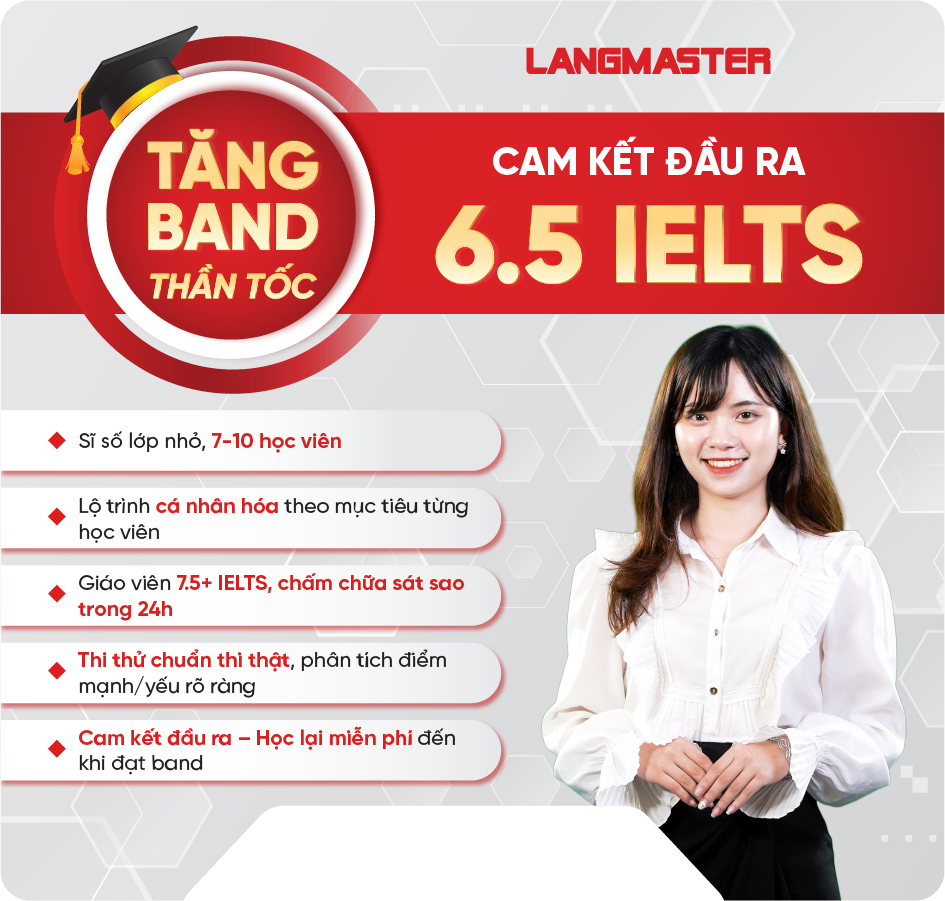
Sĩ số lớp nhỏ, 7 - 10 học viên: Giáo viên theo sát từng bạn, nhiều cơ hội trao đổi và nhận phản hồi chi tiết.
Giáo viên 7.5+ IELTS: Chấm chữa bài trong 24 giờ, giúp bạn cải thiện nhanh chóng và rõ rệt.
Thi thử định kỳ: Mô phỏng áp lực thi thật, phân tích điểm mạnh - yếu để điều chỉnh chiến lược học.
Cam kết đầu ra, học lại miễn phí: Đảm bảo kết quả, giảm thiểu rủi ro “học xong vẫn chưa đạt mục tiêu”.
Hệ sinh thái học tập toàn diện: Tài liệu chuẩn, bài tập online, cộng đồng học viên và cố vấn luôn đồng hành.
Ngoài các lớp online, hiện Langmaster còn triển khai các lớp IELTS offline tại 3 cơ sở:
169 Xuân Thủy
179 Trường Chinh
N03-T7 Ngoại giao đoàn
Hãy để lại thông tin để được tư vấn chi tiết về lộ trình phù hợp với mục tiêu của bạn.!
Trên đây là tổng hợp các bài tập Multiple Choice IELTS Reading giúp bạn luyện tập và làm quen với một trong những dạng câu hỏi phổ biến trong bài thi Reading. Hy vọng bộ bài tập trong bài viết sẽ giúp bạn nâng cao kỹ năng IELTS Reading, đồng thời xây dựng chiến lược làm bài hiệu quả hơn cho kỳ thi sắp tới. Đừng quên luyện tập đều đặn và bổ sung thêm từ vựng học thuật để đạt được band điểm IELTS mong muốn.
Các dạng bài phổ biến và tiêu chí chấm điểm IELTS Reading chi tiết nhất: Multiple Choice, Matching Information, Matching Headings,... và hướng dẫn chiến lược làm bài hiệu quả
Những sai lầm khi luyện IELTS Reading bao gồm: dịch từng từ, đọc hết cả bài, không đọc câu hỏi trước, không quản lý thời gian, không nắm vững kỹ năng paraphrase, viết sai chính tả
![Giải đề IELTS Reading: A brief history of humans and food [full answers]](https://langmaster.edu.vn/storage/images/2025/09/20/a-brief-history-of-humans-and-food-ielts-reading-answers.webp)
Giải đề thi IELTS Reading “A brief history of humans and food” kèm full đề thi thật, câu hỏi, đáp án, giải thích chi tiết, và từ vựng cần lưu ý khi làm bài.
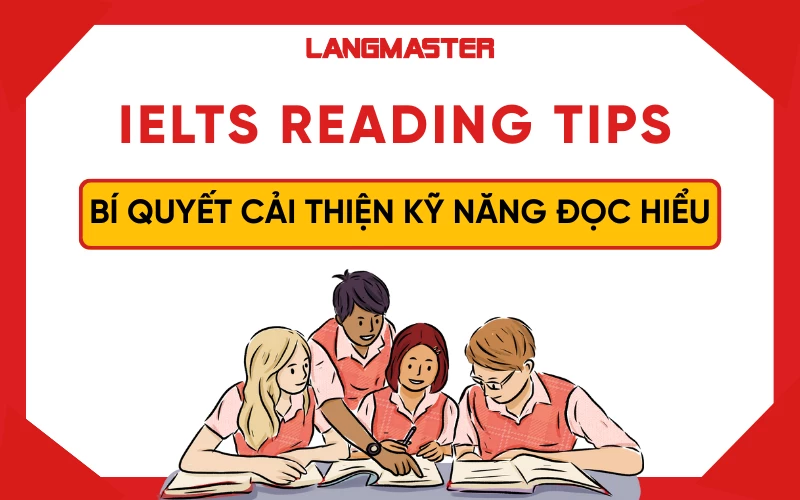
Tổng hợp IELTS Reading tips hay nhất giúp bạn đọc nhanh, nắm ý chính và xử lý thông tin chính xác, tự tin đạt điểm cao trong kỳ thi IELTS.
![Giải đề IELTS Reading: The importance of law [Full answers]](https://langmaster.edu.vn/storage/images/2025/09/22/55.webp)
Giải đề IELTS Reading “The importance of law” kèm đáp án chi tiết, từ vựng quan trọng và bí quyết luyện thi hiệu quả để nâng cao band điểm.



Hơn 16 năm kinh nghiệm, đào tạo thành công 800.000+ học viên
Phương pháp giảng dạy hiện đại, học viên tiến bộ rõ rệt
Lộ trình học chuẩn quốc tế, phù hợp với nhu cầu thực tiễn
Giáo viên đạt chuẩn Quốc tế với chất lượng top đầu thị trường, giàu kinh nghiệm
Học online linh hoạt, cam kết đầu ra bằng văn bản

![Giải IELTS Reading The dover bronze age boat [FULL ANSWERS]](https://langmaster.edu.vn/storage/uploads/original/2026/03/12/the-dover-bronze-age-boat-ielts-reading (3).png)
![Giải IELTS Reading Voyage of going beyond The blue line 2 [FULL ANSWERS]](https://langmaster.edu.vn/storage/uploads/original/2026/03/13/ielts-reading-voyage-of-going-beyond-the-blue-line-2 (2).png)
![Giải đề thi IELTS Reading ngày 01.02.2026 [FULL ANSWERS]](https://langmaster.edu.vn/storage/uploads/original/2026/03/16/giai-de-thi-ielts-reading-ngay-01-02-2026.png)